

عالمی بروکر ریگولیشن چیک کرنے والا ایپ
WikiFX
اردو
简体中文
繁體中文
English
Pусский
日本語
ภาษาไทย
Tiếng Việt
Bahasa Indonesia
Español
हिन्दी
Filippiiniläinen
Français
Deutsch
Português
Türkçe
한국어
العربية
اردو


Why Beginners Usually Start with EUR/USD, Not a Cross Pair

WikiFX
|


خلاصہ۔:A beginner-friendly explainer on direct and cross pairs, why EUR/USD is often the first learning pair, and how cross-rate math and spreads affect costs.

 فہرست
فہرستWhat Direct Pairs and Cross Pairs Actually Mean
A currency pair shows the value of one currency against another. The first currency is the base currency and the second is the quote currency. For example, EUR/USD at 1.1555 means one euro is worth 1.1555 US dollars.
In this article, a direct pair means any pair that includes the US dollar on one side. Common direct pairs are EUR/USD, GBP/USD, USD/JPY, AUD/USD, USD/CAD, and USD/CHF. A cross pair means a pair that does not include the US dollar, such as EUR/JPY, EUR/GBP, or GBP/JPY.
This classification matters for a beginner because the US dollar is the most traded currency in the world. Pairs that include USD tend to have very deep and liquid markets. Cross pairs are real quoted instruments, but their prices are derived from two USD pairs through a calculation shown later.
Pip, Spread, and Liquidity: The Basic Cost Layer
Before comparing pairs, three terms need to be clear.
- Pip: The smallest standard price movement. For most pairs, one pip is 0.0001, but for pairs quoted in JPY, one pip is 0.01.
- Spread: The difference between the bid price (where you can sell) and the ask price (where you can buy). This difference is your immediate transaction cost when you enter and exit.
- Liquidity: The amount of active buying and selling interest. High liquidity usually means narrower spreads and less price slippage. Slippage is the difference between the price you expected to get and the price your order was actually filled at.
A beginner who ignores the spread may compare only the printed price and underestimate the true cost of entering and leaving a position, which is simply a trade that is currently open.
How a Cross Rate and Wider Spreads are Built
A cross pair is not quoted in isolation. Its price is derived from the two USD pairs that link the currencies. A cross rate is the exchange rate between two currencies calculated through a third currency, usually the US dollar. For EUR/JPY, the relationship is EUR/JPY = EUR/USD × USD/JPY.
Here is a purely hypothetical calculation using reference levels, not live quotes:
- Take EUR/USD at 1.1555.
- Take USD/JPY at 158.641 (rounded).
- Multiply: 1.1555 × 158.641 = 183.31, which is the EUR/JPY cross rate.
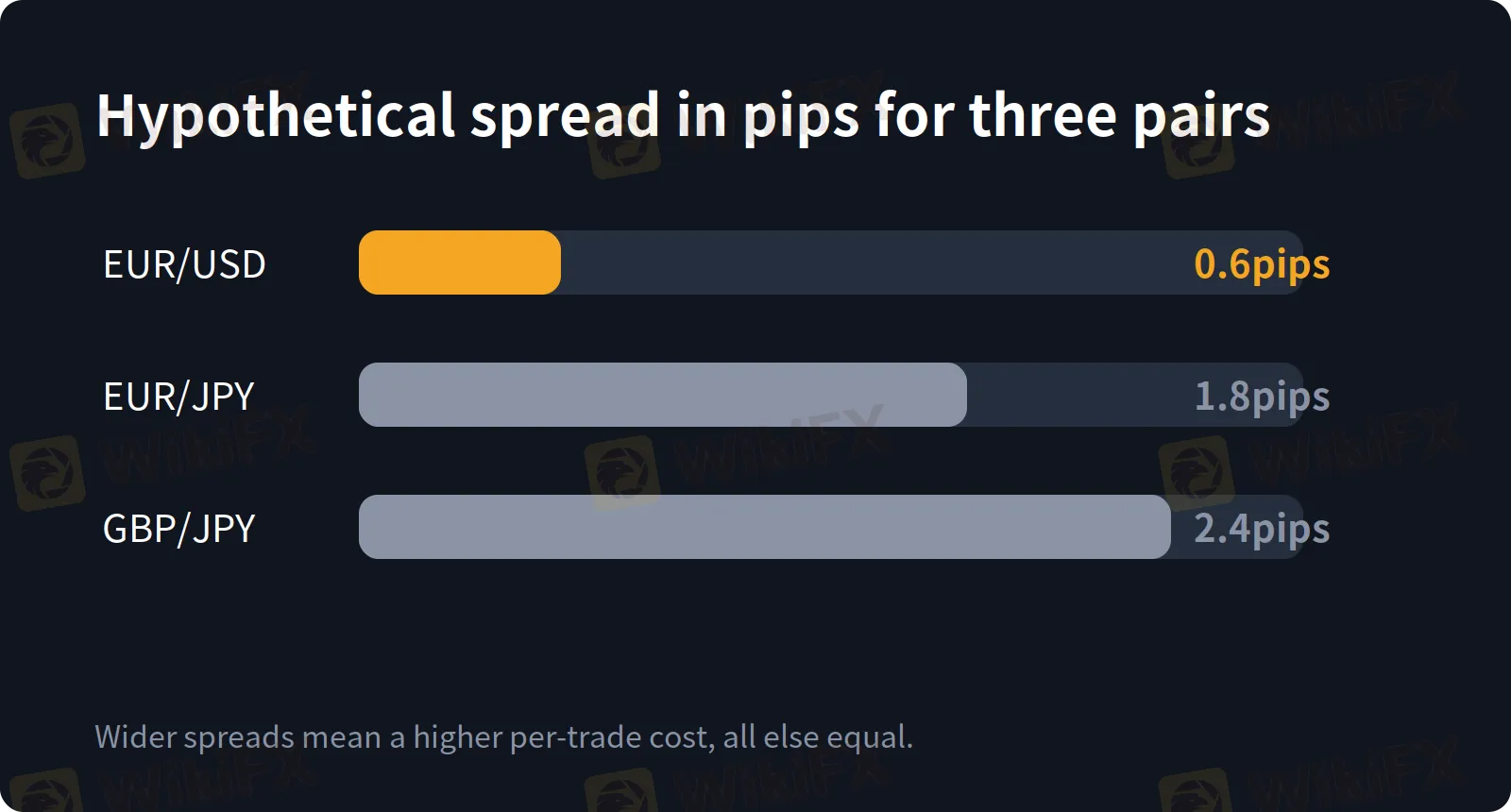
Hypothetical retail spreads only, not live quotes.
What Starting with EUR/USD Does and Does Not Mean
The most common misunderstanding is that a cross pair is broken or dangerous just because it does not contain USD. That is not true. Cross pairs are standard instruments, but their liquidity tends to be thinner than major direct pairs, especially outside the main London and New York trading hours. Thin liquidity can increase slippage and widen spreads.
Other frequent misreadings:
- EUR/USD is not risk-free. It is highly liquid, but it still moves sharply on economic news and central bank decisions. With leverage, a small adverse move can produce a large loss. Leverage means using borrowed money from your broker to control a larger position than your cash deposit would allow.
- A lower printed price does not mean a pair is cheaper to trade. EUR/USD around 1.1555 and EUR/JPY around 183.31 have different pip values and margin requirements, so comparing price alone is misleading. Pip value is the money value of one pip for a given trade size, and margin requirement is the amount your broker holds as a deposit while a leveraged trade is open.
- The spread shown in calm conditions is not fixed. During news releases or low-liquidity hours, spreads can widen several times. Order flow, which is the direction and volume of active buy and sell orders, can shift quickly and change the cost of execution.
Starting with EUR/USD is a learning convenience, not a safer outcome. The pair offers deep liquidity, a narrow spread in normal conditions, and simpler pip arithmetic for a beginner. That makes it easier to observe how price, spread, and order flow interact.
It is not a promise that you will lose less, a prediction that EUR/USD will move in a particular direction, or a reason to use larger leverage. It is simply a place where the basic mechanics of forex are easier to see. Any trading decision, including whether to trade at all, remains a personal decision based on your own risk and financial situation.
This is education, not investment advice.
ڈس کلیمر:
یہ مضمون صرف مصنف کی ذاتی رائے پر مبنی ہے، یہ پلیٹ فارم کی سرمایہ کاری کی مشورہ نہیں ہے۔ پلیٹ فارم مضمون کی معلومات کی درستگی، مکملیت اور بروقت ہونے کی کوئی ضمانت نہیں دیتا، اور مضمون کی معلومات پر اعتماد یا استعمال سے ہونے والے کسی بھی نقصان کی ذمہ داری قبول نہیں کرتا۔
