

عالمی بروکر ریگولیشن چیک کرنے والا ایپ
WikiFX
اردو
简体中文
繁體中文
English
Pусский
日本語
ภาษาไทย
Tiếng Việt
Bahasa Indonesia
Español
हिन्दी
Filippiiniläinen
Français
Deutsch
Português
Türkçe
한국어
العربية
اردو


Why Your Forex Feed Only Shows Winners

WikiFX
|


خلاصہ۔:Social media feeds are filtered to show winning trades and hide losing ones, creating survivorship bias. This article explains how that distortion works and offers a simple self-observation exercise to keep your trading expectations grounded.

You open your trading app, then Instagram or Telegram. Someone has just posted a screenshot of a green account, a profit curve that climbs like a staircase. You feel behind.
The first thought is usually not “that is a selection problem”; it is “what am I doing wrong?” This article explains that selection problem.
 فہرست
فہرستWhen the feed only shows the winners
Survivorship bias is the error of focusing on people or outcomes that made it past some filter and ignoring those that did not. On social media the filter is brutal: losing trades do not get posted. Winning trades get posted, screenshotted, edited, and shared again. The result is a feed that looks much more successful than the actual pool of traders.
To make it concrete, here is a purely hypothetical teaching example. Imagine 100 beginners start a simple forex (foreign exchange) strategy at the same time. After one month, 60 people lose money, 30 roughly break even, and 10 make a small profit.
If only the 10 profitable traders post their results, and each posts twice, a follower scrolling quickly sees 20 winning posts and zero visible losses. That follower may conclude the success rate is close to 100 percent, when the real profitable share is only 10 out of 100. The numbers are invented only to show how the illusion works, not a real market forecast.
- Losing accounts rarely post because the loss feels private or shameful.
- Platforms amplify high-engagement wins, pushing more losses out of view.
- Edited or old screenshots circulate without context, making one good week look like a permanent edge.
Why screenshots fool your brain
This is not about intelligence. The brain uses shortcuts. The availability heuristic makes you estimate how common something is by how easily examples come to mind.
When your feed is flooded with wins, winning feels common even if it is rare. Social proof, the tendency to follow what many others appear to do, adds pressure: if many people seem to be doing well, you may feel that not joining is the riskier choice.
Another trap is base rate neglect, which means ignoring the full group size when judging a sample. You see 20 winning screenshots and stop asking “20 out of how many?” Without the denominator, a screenshot is just a bright picture. Your emotional brain treats it as evidence, but it is not complete evidence.
Observe your own reactions:
- After seeing a win screenshot, do you feel an urge to trade immediately?
- Do you compare your recent break-even week with someone elses best day?
- Do you search for the same method because someone else appeared to profit?
- Do you skip asking whether the screenshot shows a demo account (a practice account with virtual money), a short period, or a selectively edited history?
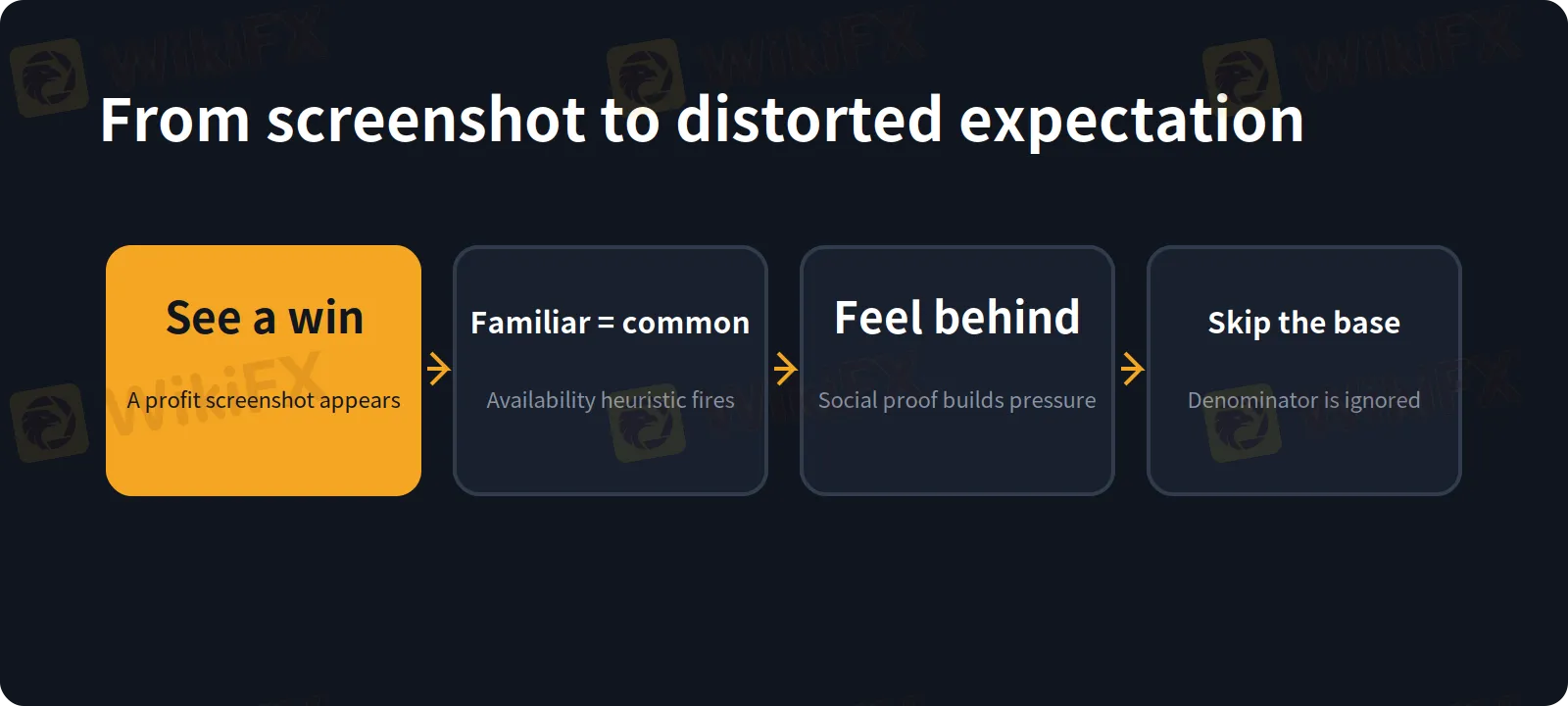
A typical mental path from seeing a win screenshot to an inflated expectation.
A quiet test you can run on yourself
You do not need anyones permission to change how you consume trading content. A simple self-observation routine can weaken the illusion without telling you what to trade.
For one week, before opening social media, write down your current belief: “How many of my peers are profitable this month?” Then note how many profit posts you actually see. After the session, ask whether that count tells you anything about the full group.
- Record only what you saw, not how it made you feel.
- Separate entertainment from evidence: a win screenshot is a story, not a statistical sample.
- When you see a screenshot, ask what the missing denominator might be.
- Revisit your own trading journal, not someone elses highlight reel.
This is not about ignoring social media completely. It is about noticing that social media is a curated exhibit. A museum shows its best paintings in good light; it does not show the rejected canvases.
Keep your expectations grounded
A realistic view of trading is already hard enough without a distorted social feed. Survivorship bias inflates your belief about how often ordinary traders win, and inflated expectations can lead to overtrading (trading too often or too large) or revenge trading (trading to quickly recover a loss). They can also lead you to pay for a “winning” method that was never tested on a full sample.
One practical mental habit is to treat every screenshot as an unverified claim until it comes with a full statement, a clear sample period, and ideally a third-party verified performance record. Most social posts do not. That does not make them lies; it makes them incomplete.
- A single profit screenshot is not evidence of a strategy.
- A string of green days (profitable days) may be cherry-picked (only the best days are shown); the red days may simply not be shown.
- A popular account may be popular because it posts wins, not because it trades well.
- Your own long-term record, with every entry and exit recorded, is more useful than someone elses screenshot.
At the end of a scrolling session, the most useful question is not “why are they winning and I am not?” The most useful question is “what information did I actually receive, and what is still missing?” Keep that gap in mind, and your expectations can stay closer to reality.
ڈس کلیمر:
یہ مضمون صرف مصنف کی ذاتی رائے پر مبنی ہے، یہ پلیٹ فارم کی سرمایہ کاری کی مشورہ نہیں ہے۔ پلیٹ فارم مضمون کی معلومات کی درستگی، مکملیت اور بروقت ہونے کی کوئی ضمانت نہیں دیتا، اور مضمون کی معلومات پر اعتماد یا استعمال سے ہونے والے کسی بھی نقصان کی ذمہ داری قبول نہیں کرتا۔
