


FOMC Minutes Today: 3 USD and Gold Scenarios Traders Should Prepare For
The Fed releases the July FOMC minutes on 19 August 2026. Here are three USD and gold scenarios, confirmation signals, and a practical risk checklist for traders.
Original

简体中文
繁體中文
English
Pусский
日本語
ภาษาไทย
Tiếng Việt
Bahasa Indonesia
Español
हिन्दी
Filippiiniläinen
Français
Deutsch
Português
Türkçe
한국어
العربية
اردو




Abstract:The DOJ has filed an antitrust lawsuit against Visa, accusing it of suppressing competition with high debit swipe fees, impacting merchants and consumers in the U.S.

Visa, one of the world's major payment networks, is facing legal difficulty after the US Department of Justice (DOJ) launched an antitrust action against it. The complaint claims Visa is monopolizing the debit card business by limiting competition, charging exorbitant merchant fees, and paying off prospective competitors. This measure is part of the Biden administration's larger attempts to combat growing consumer expenses, particularly as the November 2024 presidential election approaches.
 Contents
The DOJ claims that Visa violated antitrust laws by leveraging its dominant position in the US debit card industry to stifle competition. According to the DOJ, Visa handles more than 60% of debit card transactions in the United States and collects $7 billion in fees each year. These costs, also known as swipe or interchange fees, are charged each time a debit card transaction is completed over Visa's network.
Prosecutors contend that Visa has maintained its dominating position via exclusive arrangements with card issuers, retailers, and even rivals. These agreements purportedly restrict other businesses from entering the debit card processing industry, hence strengthening Visa's market dominance. Consequently, competition is inhibited, and merchants and customers are left to suffer the burden of excessive costs.
The DOJ is seeking a court injunction to prohibit Visa from continuing these activities. They claim that Visa's pricing strategies and partnerships with competitors intentionally inhibit competition, resulting in increased prices for both companies and consumers. If successful, the action may cause a significant change in the payment processing business, allowing more rivals to join the market.
Attorney General Merrick Garland underscored Visa's far-reaching influence: “Visa's unlawful conduct affects not just the price of one thing, but the price of nearly everything.” Visa's activities, which hinder competition in the debit card industry, lead to increased overall prices since companies pass on the fees to customers.

Julie Rottenberg, Visa's general counsel, vigorously disputed the complaint, stating that the corporation operated in a highly competitive industry. Rottenberg said that Visa delivers a safe, dependable, and efficient network that companies and customers choose because of the value it provides, which includes fraud prevention. She highlighted that Visa would fiercely defend itself against the DOJ's allegations, claiming that they are without merit.
Despite Visa's response, the company's shares fell by around 5.5% on Tuesday upon the news of the lawsuit. Investors are keenly monitoring the issue since any changes to Visa's business procedures may have severe consequences for the company's financial prospects and the payment processing industry as a whole.
The action is part of the Biden administration's more significant attempts to combat increasing consumer costs, which have emerged as a significant issue in the approaching presidential race. The government has been investigating the role of giant firms, notably those in the financial services sector, in raising consumer expenses.
Visa's alleged anticompetitive behavior extends back to 2012 when regulations forced card issuers to accept unaffiliated networks. Prosecutors allege that Visa struck into lucrative arrangements with businesses such as Apple, PayPal, and Block Inc.'s Square to prevent them from introducing products that might threaten its supremacy. The DOJ claims that these transactions were aimed to limit competition and retain Visa's dominance in the debit card industry.
PayPal refused to comment on the complaint, while Apple and Block did not return calls for comment.
In addition to the exclusivity agreements, the complaint claims that Visa imposes harsh financial penalties on retailers that process transactions using alternative networks. According to prosecutors, these sanctions dissuade retailers from exploring other payment processing options, thus strengthening Visa's market position.
In 2021, the Justice Department's antitrust division initiated an investigation into Visa's debit card activities. That same year, the agency denied Visa's bid to purchase financial technology startup Plaid, which would have strengthened Visa's position in the fintech market. Mastercard, Visa's rival, is also being investigated for similar actions since both corporations have been sued over market domination for over two decades.
In 2019, Visa and Mastercard agreed to pay US merchants $5.6 billion to resolve a class action lawsuit accusing them of anticompetitive practices. A federal court in Brooklyn recently rejected a deal that would have decreased swipe fees by $30 billion over five years while also requiring Visa and MasterCard to loosen some of its merchant-restrictive restrictions.
As the DOJ's case against Visa continues, the payment network behemoth has set aside $1.6 billion for future interchange fee settlements. The case will be widely followed by financial sector professionals, retail merchants, legal experts, and consumers since the conclusion has the potential to transform the landscape of debit card transactions in the United States.
Stay updated on the Visa antitrust lawsuit and its impact on debit card fees and competition. For more insights, visit news.html" target="_self" style="color: rgb(46, 82, 153);">WikiFX News now!

Disclaimer:
The views in this article only represent the author's personal views, and do not constitute investment advice on this platform. This platform does not guarantee the accuracy, completeness and timeliness of the information in the article, and will not be liable for any loss caused by the use of or reliance on the information in the article.
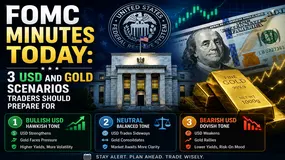
The Fed releases the July FOMC minutes on 19 August 2026. Here are three USD and gold scenarios, confirmation signals, and a practical risk checklist for traders.

India's rupee is expected to open near 95.14-95.16 per US dollar after closing at 95.2075 on Friday, while Brent crude was quoted at $84.50 and RBI market presence supported the currency. This report separates a reported market intervention from a fixed exchange-rate target, explains why oil, US employment data and Federal Reserve expectations matter, and gives a practical risk checklist for forex trading India. It also explains why volatility is not a reason to trust unverified online forex trading platforms.

The Reserve Bank of India has appointed Monisha Chakraborty as Executive Director with effect from 3 August 2026; she will oversee the Foreign Exchange Department and the Financial Markets Regulation Department. Chakraborty is a career central banker with over three decades of experience in Supervision, Foreign Exchange, and Government and Bank Accounts, and previously served as Banking Ombudsman. This report explains the significance of the new RBI Executive Director appointment for forex regulation India, the scope of the Foreign Exchange Department and the Financial Markets Regulation Department, and what authorised persons, banks, and forex market participants should monitor as the new ED takes charge.

RBI's concessional forex swap facility had mobilised $40.82 billion by 31 July 2026, with FCNR(B) deposits providing $36.725 billion of the total. This India-focused analysis separates confirmed inflows from the $80–85 billion SBI Research projection, compares the 2026 programme with the 2013 FCNR(B) window, and explains what the numbers can—and cannot—do for the Indian rupee. It also shows how banks, NRI depositors, importers, exporters and institutional investors may be affected, while highlighting the oil, dollar, maturity and hedging risks that still matter for USD/INR and forex trading in India.
WikiFXWikiFXWikiFXWikiFXWikiFXWikiFXWikiFXWikiFXWikiFXWikiFX