


FOMC Minutes Today: 3 USD and Gold Scenarios Traders Should Prepare For
The Fed releases the July FOMC minutes on 19 August 2026. Here are three USD and gold scenarios, confirmation signals, and a practical risk checklist for traders.
Original

简体中文
繁體中文
English
Pусский
日本語
ภาษาไทย
Tiếng Việt
Bahasa Indonesia
Español
हिन्दी
Filippiiniläinen
Français
Deutsch
Português
Türkçe
한국어
العربية
اردو




Abstract:Despite a recent short-term rebound in the British pound, a number of macroeconomic risks are emerging. Major institutions expect the pound to come under pressure in the second half of the year. Investors should closely monitor future policy and market dynamics.
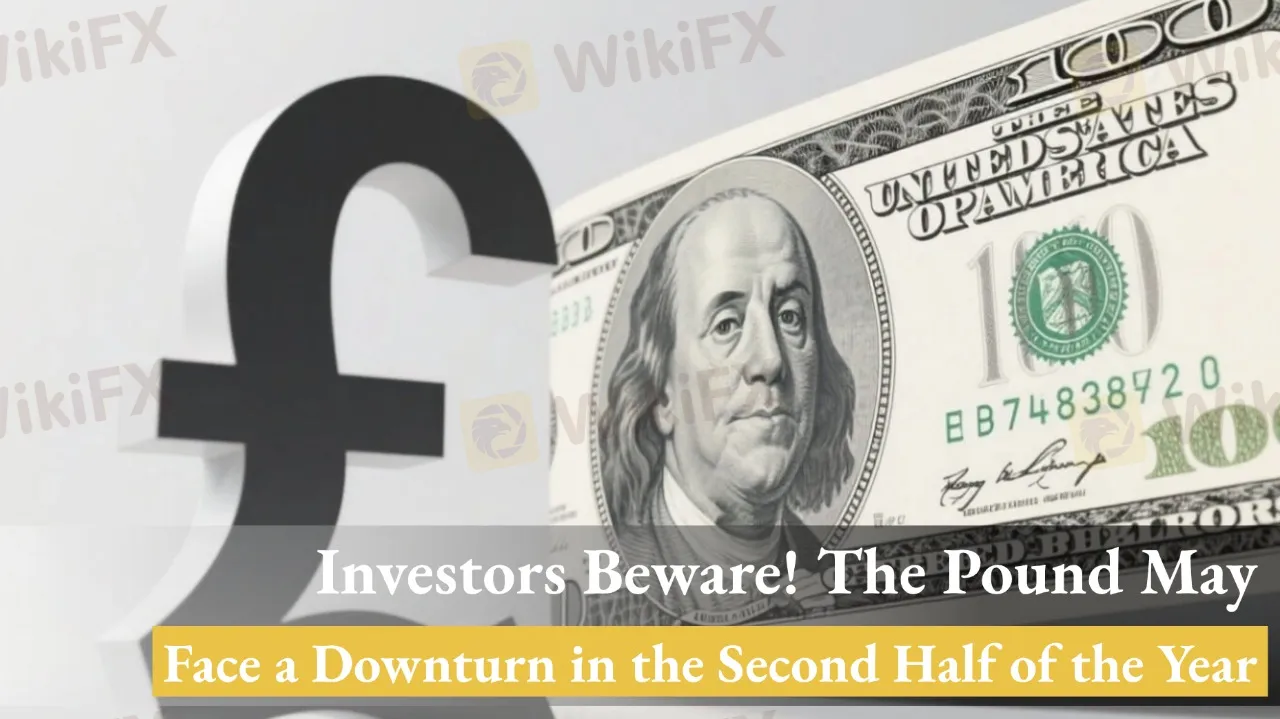
Since early June, the British pound has been fluctuating against the U.S. dollar. On Monday, the pair opened around 1.3400 and climbed to near 1.3445, yet its short-term trend remains bearish, as GBP/USD is still below the 20-day exponential moving average (EMA) of 1.3477.
The 14-day Relative Strength Index (RSI) ranges between 40 and 60, hovering near the neutral level of 50, indicating a lack of strong directional momentum. On the downside, the May 16 low around 1.3250 serves as key support. On the upside, a breakthrough above the three-year high of 1.3630 would be needed to establish a new bullish trend.
Earlier this month, GBP briefly topped 1.36—its highest in 40 months—but failed to hold gains and has since retreated to below 1.35, reflecting market caution about further appreciation.
ING, a major European financial institution, maintains a cautious view on the pounds outlook. While the bank expects the U.S. dollar to remain weak overall, it does not foresee significant further downside. It predicts GBP/USD will retreat to 1.33 in six months and is unlikely to break above 1.40.
ING's cautious stance is based on several factors:
Sluggish UK economic prospects:
The bank warns of deteriorating domestic demand, a weakening labor market, and persistent inflationary pressures—all of which threaten to stall economic recovery.
Rising fiscal burdens:
Tax hikes are expected in the autumn, which could further dampen consumer sentiment and increase the likelihood of a Bank of England rate cut—both bearish for the pound.
Unclear monetary policy direction:
With inflation still a concern but growth faltering, the Bank of England faces tough choices. A shift toward monetary easing would undermine sterling.
Even though market sentiment toward the dollar remains negative, ING believes most bad news is already priced in. This would limit the dollar's downside and cap GBP/USD gains.
Heading into the second half of the year, markets face increasing complexity:
Global macro uncertainty:
The Federal Reserves monetary stance remains in flux. A dollar rebound could weigh heavily on the pound.
Geopolitical tensions and trade frictions:
Shifting investor sentiment due to global instability could drive flows toward safer currencies, hurting GBP demand.
UKs structural economic vulnerabilities:
Ongoing issues in productivity, investment, and policy clarity could deter capital inflows and restrain GBP upside.
The anticipated weakening of the pound will affect various investor groups:
Retail investors holding GBP-denominated assets may see lower returns when converted to other currencies.
Businesses involved in international trade could face rising import costs and squeezed profit margins.
Individuals planning overseas expenses—e.g., for travel, education, or healthcare—may experience increased costs if the pound weakens further.
To protect themselves, investors should reassess their exposure to pound-related assets and consider using hedging instruments such as options, forwards, or multi-currency portfolios to reduce risk.
Understanding the core factors influencing the pound can help investors make informed decisions. Here are five key drivers:
1. UK economic performance:
GDP growth, employment data, and inflation figures provide the foundation for currency valuation. Strong data usually supports the pound.
2. Interest rate expectations:
Monetary policy decisions by the Bank of England (BoE) directly affect GBP strength. Signals of rate cuts typically depress the pound.
3. Capital flows:
Global investor sentiment and capital movement into or out of the UK influence demand for the pound.
4. Relative currency performance:
The pound often trades in tandem with or against major currencies like the U.S. dollar and euro. Their performance impacts GBP indirectly.
5. Technical and sentiment indicators:
Traders and algorithms respond to price patterns, support/resistance levels, and momentum indicators, which can drive short-term volatility.
Though the pound has shown resilience in the early half of the year, fundamental and technical pressures are building. A downturn in the second half of the year appears increasingly likely. Investors should stay informed, diversify their portfolios, and consider protective strategies to manage forex risks. The coming months will be critical in determining the pounds longer-term trajectory.

Disclaimer:
The views in this article only represent the author's personal views, and do not constitute investment advice on this platform. This platform does not guarantee the accuracy, completeness and timeliness of the information in the article, and will not be liable for any loss caused by the use of or reliance on the information in the article.
The Fed releases the July FOMC minutes on 19 August 2026. Here are three USD and gold scenarios, confirmation signals, and a practical risk checklist for traders.

A Prime of Prime forex arrangement can help a broker access trading relationships, credit intermediation, technology connectivity, and liquidity aggregation that may otherwise be difficult to obtain directly. But the label does not prove direct bank access, executable depth, or a particular execution outcome. This 2026 guide explains what a forex Prime of Prime, PoP liquidity provider, prime brokerage forex service, and forex prime broker proposal can mean in practice; where the credit and order-routing chain must be documented; how to test pricing, limits, rejects, records, and resilience; and which commercial terms create hidden operating cost. Use the comparison framework, red-flag list, and 90-day launch plan to assess fit for your client mix and risk model. The objective is a controllable execution dependency with traceable evidence, not a marketing claim about institutional access.
FINEX review 2026 for readers comparing an Indonesia forex broker: understand what Bappebti's A+++ rating does and does not show, then check floating spreads, withdrawals, segregated accounts and the complaint route for PT Finex Bisnis Solusi Futures.
Choosing a forex liquidity provider is not a search for the lowest displayed spread or the longest provider list. It is a broker decision about pricing integrity, depth, routing, credit, reporting, incident response, and client communication. This 2026 guide explains how a forex LP, FX liquidity provider, or liquidity provider forex arrangement fits into a broker’s execution chain; what to test before onboarding; why a “best forex liquidity provider” claim cannot replace due diligence; and how to compare cost beyond commission. Use the execution-quality scorecard, provider questions, routing scenarios, and 90-day onboarding plan to assess whether a liquidity relationship can support your actual client mix, instruments, risk model, and jurisdiction. The goal is not to make a universal ranking. It is to build evidence that your broker can explain, supervise, reconcile, and recover its execution service when market conditions are difficult.
WikiFXWikiFXWikiFXWikiFXWikiFXWikiFXWikiFXWikiFXWikiFXWikiFX