


FOMC Minutes Today: 3 USD and Gold Scenarios Traders Should Prepare For
The Fed releases the July FOMC minutes on 19 August 2026. Here are three USD and gold scenarios, confirmation signals, and a practical risk checklist for traders.
Original

简体中文
繁體中文
English
Pусский
日本語
ภาษาไทย
Tiếng Việt
Bahasa Indonesia
Español
हिन्दी
Filippiiniläinen
Français
Deutsch
Português
Türkçe
한국어
العربية
اردو




Abstract:The Reserve Bank of India (RBI) has introduced the Offline Digital Rupee (e₹), a groundbreaking initiative that facilitates secure real-time digital payments without mobile or Internet connectivity. It is a move aimed at deepening the country’s digital financial ecosystem. Launched at the Global Fintech Fest 2025, the move adds a significant feather to India’s continual journey toward a cashless and financially inclusive economy.
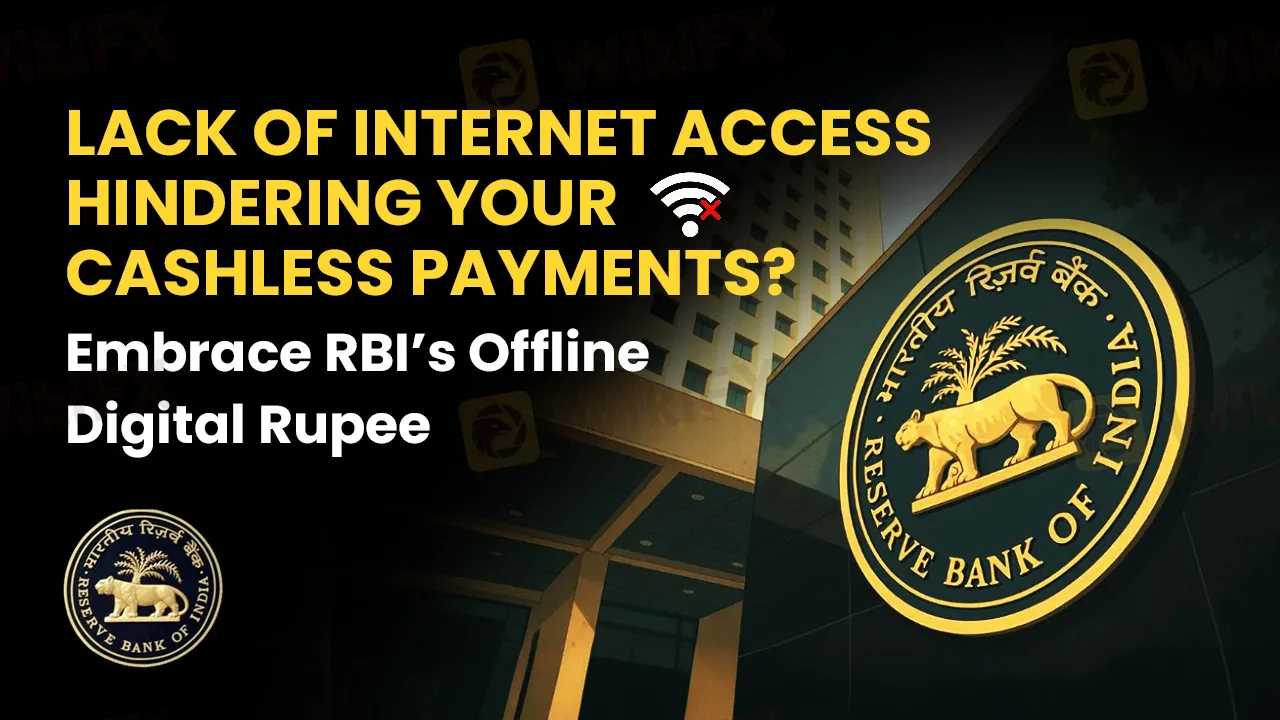
The Reserve Bank of India (RBI) has introduced the Offline Digital Rupee (e₹), a groundbreaking initiative that facilitates secure real-time digital payments without mobile or Internet connectivity. It is a move aimed at deepening the country‘s digital financial ecosystem. Launched at the Global Fintech Fest 2025, the move adds a significant feather to India’s continual journey toward a cashless and financially inclusive economy.
Contrary to UPI and other online payment systems requiring Internet connectivity and linked bank accounts, the new initiative facilitates direct transfers within wallets, a financially defining moment for rural and remote locations with limited banking infrastructure or network access. With no reliance on online networks for payments, millions of unbanked and underbanked citizens can enjoy secure digital transactions.
The new initiative, i.e., e₹, incorporates two transformative technologies for seamless offline digital payments - Near Field Communication (NFC) and Telecom-Assisted Payments. While NFC allows instant fund transfers within NFC-enabled devices using a simple tap, telecom-assisted payments facilitate transactions even under the least network availability. All these ensure simple, seamless, and universal digital transactions.
Users can seamlessly access e₹ through the digital wallets of 15 participating banks. The bank list includes the State Bank of India (SBI), ICICI Bank, and HDFC Bank. Here are the salient features of this initiative.
Users can access wallets through official banking apps.
The new initiative comes with a new dimension - Programmable Money - by which funds can be geofenced for use within certain areas, remain time-bound for usage within a set period, or be limited to specific needs. These features make the e₹ especially beneficial for government welfare schemes, benefit reimbursements, and corporate payrolls. This ensures that funds are utilized as intended, boosting accountability and transparency.
RBI Governor Sanjay Malhotra hailed e₹ as a transformative step in India‘s digital evolution. He stated that the Offline Digital Rupee enhances India’s digital public infrastructure by providing a secure, reliable, and inclusive payment solution to citizens across the country. The initiative helps India enter into a select group of countries having witnessed a successful Central Bank Digital Currency (CBDC) with offline functionality.
According to experts, this RBI initiative will aid in financial inclusion, especially among rural and low-income populations with network or banking barriers. Other likely benefits include reduced reliance on cash, improved payment experience, and smart government transfers and corporate settlements.
Summing Up
The launch of the Offline Digital Rupee (e₹) marks a significant milestone in Indias digital finance revolution. By enabling seamless payments without Internet or mobile connectivity, the RBI has addressed one of the most critical barriers to financial inclusion. With advanced technologies like NFC and telecom-assisted payments, and features such as programmable money, the e₹ stands as a forward-looking solution that bridges the digital divide. As the initiative expands through leading banks and gains public adoption, it is poised to redefine the way India transacts—empowering every citizen to be part of a truly cashless and connected economy.
For more insights on forex brokers, trader ratings, and key market updates, join our official chat groups — your gateway to a remarkable forex trading journey - through any of the below QR codes or ID:EODL15W5IH.

Disclaimer:
The views in this article only represent the author's personal views, and do not constitute investment advice on this platform. This platform does not guarantee the accuracy, completeness and timeliness of the information in the article, and will not be liable for any loss caused by the use of or reliance on the information in the article.
The Fed releases the July FOMC minutes on 19 August 2026. Here are three USD and gold scenarios, confirmation signals, and a practical risk checklist for traders.

Choosing a forex liquidity provider is not a search for the lowest displayed spread or the longest provider list. It is a broker decision about pricing integrity, depth, routing, credit, reporting, incident response, and client communication. This 2026 guide explains how a forex LP, FX liquidity provider, or liquidity provider forex arrangement fits into a broker’s execution chain; what to test before onboarding; why a “best forex liquidity provider” claim cannot replace due diligence; and how to compare cost beyond commission. Use the execution-quality scorecard, provider questions, routing scenarios, and 90-day onboarding plan to assess whether a liquidity relationship can support your actual client mix, instruments, risk model, and jurisdiction. The goal is not to make a universal ranking. It is to build evidence that your broker can explain, supervise, reconcile, and recover its execution service when market conditions are difficult.
India's rupee is expected to open near 95.14-95.16 per US dollar after closing at 95.2075 on Friday, while Brent crude was quoted at $84.50 and RBI market presence supported the currency. This report separates a reported market intervention from a fixed exchange-rate target, explains why oil, US employment data and Federal Reserve expectations matter, and gives a practical risk checklist for forex trading India. It also explains why volatility is not a reason to trust unverified online forex trading platforms.
The Reserve Bank of India has appointed Monisha Chakraborty as Executive Director with effect from 3 August 2026; she will oversee the Foreign Exchange Department and the Financial Markets Regulation Department. Chakraborty is a career central banker with over three decades of experience in Supervision, Foreign Exchange, and Government and Bank Accounts, and previously served as Banking Ombudsman. This report explains the significance of the new RBI Executive Director appointment for forex regulation India, the scope of the Foreign Exchange Department and the Financial Markets Regulation Department, and what authorised persons, banks, and forex market participants should monitor as the new ED takes charge.
WikiFXWikiFXWikiFXWikiFXWikiFXWikiFXWikiFXWikiFXWikiFXWikiFX