




OANDA Review 2026 for India
OANDA review for India covering global regulation, RBI forex rules, OANDA login security, platforms and regulatory history.
Original

简体中文
繁體中文
English
Pусский
日本語
ภาษาไทย
Tiếng Việt
Bahasa Indonesia
Español
हिन्दी
Filippiiniläinen
Français
Deutsch
Português
Türkçe
한국어
العربية
اردو




Abstract:Octa vs XTB Showdown: One Is Banned By The RBI, The Other Has 24 Years Of Stock-Market Pedigree — Which Should Indian Traders Actually Trust In 2026? If you are an Indian trader who has done even a casual Google search for forex brokers, two names will have crossed your screen — Octa (formerly OctaFX) and XTB. Both are widely advertised, both have massive global followings, and both claim to offer competitive trading conditions for retail traders. But these two brokers could not be more different in their philosophy, regulation, and legal standing in India. Octa is a mobile-first, high-leverage, beginner-friendly offshore broker that has rapidly grown across emerging markets — including, controversially, India. XTB is a 24-year-old publicly-listed European broker with deep Tier-1 regulation that has specifically chosen NOT to accept Indian clients in 2026. Yes, you read that right. XTB does not accept Indian residents. And Octa, the one that does serve Indian residents, has been adde
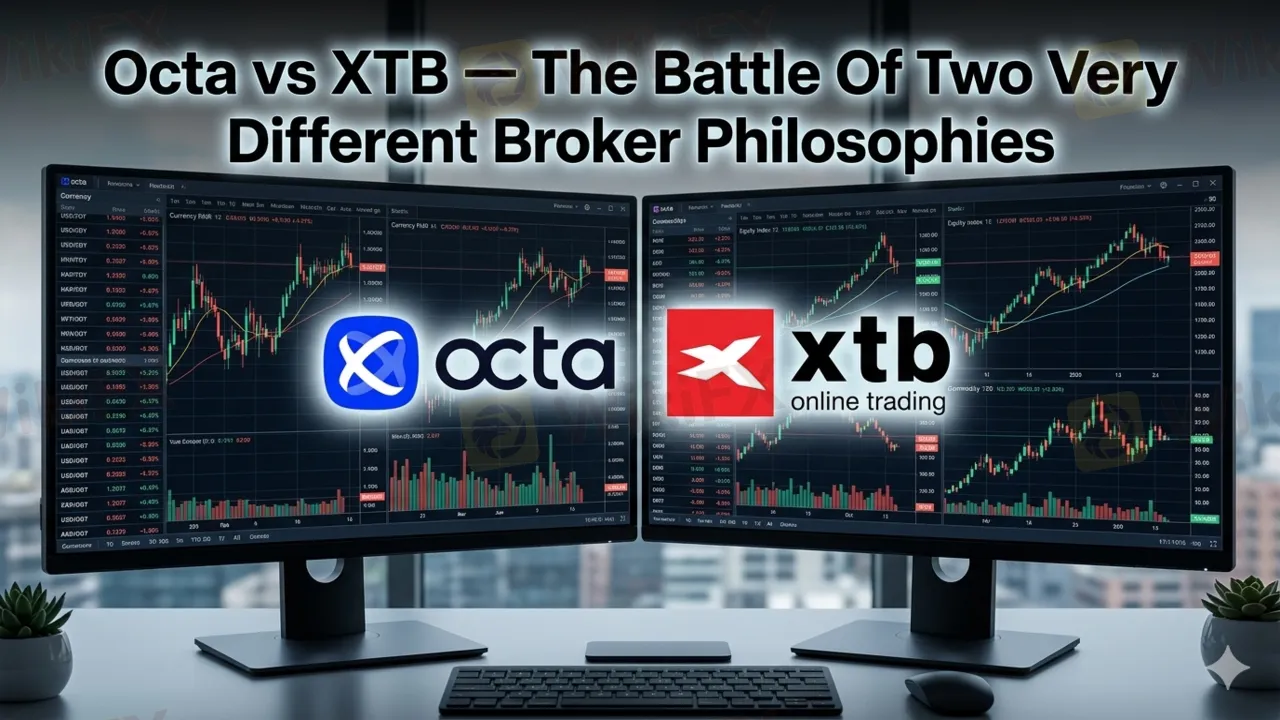
If you are an Indian trader who has done even a casual Google search for forex brokers, two names will have crossed your screen — Octa (formerly OctaFX) and XTB. Both are widely advertised, both have massive global followings, and both claim to offer competitive trading conditions for retail traders.
But these two brokers could not be more different in their philosophy, regulation, and legal standing in India. Octa is a mobile-first, high-leverage, beginner-friendly offshore broker that has rapidly grown across emerging markets — including, controversially, India. XTB is a 24-year-old publicly-listed European broker with deep Tier-1 regulation that has specifically chosen NOT to accept Indian clients in 2026.
Yes, you read that right. XTB does not accept Indian residents. And Octa, the one that does serve Indian residents, has been added to the Reserve Bank of India's Alert List of unauthorised forex brokers.
This is the comparison that explains why one of them got blacklisted and the other refuses to operate where it cannot legally comply. By the end of this article, you will understand a crucial truth about retail forex: the broker that wants your business the most aggressively is often the one you should trust the least.
Indian retail traders face a unique double bind. On one hand, SEBI does not authorise offshore forex brokers for retail clients, so every international broker accessible to Indians operates in a legal grey zone. On the other hand, Indian domestic platforms offer extremely limited forex product range and very conservative leverage.
In this environment, broker comparison is not a luxury — it is a survival skill. The wrong broker choice can mean:
Comparing brokers across regulation, operational history, user feedback, and trading conditions — the way WikiFX does it — is the only defence retail traders have. Now let us do exactly that for Octa and XTB.
| Criteria | Octa (formerly OctaFX) | XTB (X-Trade Brokers) |
| Founded | 2011 | 2002 |
| Headquartered | Saint Lucia (international) | Warsaw, Poland (publicly listed) |
| Regulators (Verified) | CySEC (Cyprus, EU clients only), FSA Saint Vincent and the Grenadines, MISA (Mwali/Comoros), FSC Mauritius | FCA (UK), CySEC (Cyprus), KNF (Poland), CNMV (Spain), CMA (Kenya), and more — multi-tier |
| Indian Regulatory Status | Listed on RBI Alert List (October 2024) — unauthorised | Does not accept Indian clients (compliant by choice) |
| Operating Period | 14 years | 24 years (publicly listed on Warsaw Stock Exchange) |
| Trading Platforms | MT4, MT5, OctaTrader (proprietary), OctaTrader mobile | xStation 5 (proprietary, award-winning), MT4 |
| Minimum Deposit | USD 20 (very low entry) | USD 0 (no minimum on Standard) |
| EUR/USD Spread (Standard) | From 0.6 pips | From 0.5 pips |
| Commission | Zero commission (mark-up in spread) | Commission for withdrawal to Skrill, Neteller and PayRetailers - 1%, Commission for a transaction on Cryptocurrencies CFDs – for opening and closing (Cryptocurrencies CFDs are not available for Islamic Accounts - 4% |
| Maximum Leverage | 1:500 to 1:1000 (international) | 1:500 (international), 1:30 (EU/UK retail) |
| Tradable Instruments | Approx. 260+ (forex, commodities, indices, crypto, stocks) | 11,700+ instruments (forex, indices, stocks, ETFs, crypto, commodities) |
| Islamic Account | Yes (swap-free by default on all accounts) | Yes |
| Investor Compensation | Limited (offshore entities) | Up to GBP 85,000 (FCA), EUR 20,000 (CySEC) |
| Public Listing | Private | Listed on Warsaw Stock Exchange (transparent financials) |
This is the single most important section of the comparison. Read it carefully.
Octa's Indian Status (the bombshell):
In October 2024, the Reserve Bank of India officially added Octa (and its predecessor entity OctaFX) to its Alert List of unauthorised forex trading platforms. This is not a rumour, not speculation — it is a documented RBI list of forex brokers that Indian residents are warned against.
What does this mean practically?
Octa's primary regulator for non-EU clients is MISA (Mwali International Services Authority) in Comoros — an offshore-tier regulator with minimal enforcement teeth. The CySEC licence applies only to EU clients, which excludes you if you are in India.
XTB's Indian Status (the surprise):
XTB has decided not to accept Indian residents as clients. This sounds like a negative until you understand why. XTB operates under FCA (UK) and CySEC (Cyprus) Tier-1 regulation, and accepting Indian clients without proper authorisation would expose the broker to regulatory action in its home jurisdictions. Rather than risk that, XTB simply does not onboard Indian users.
Quick Term Explainer — “Tier-1 vs Offshore Regulation”: Tier-1 regulators (FCA, ASIC, CFTC) require minimum capital reserves of USD 1 million+, segregated client funds, regular audits, and have real enforcement teeth. Offshore regulators (MISA, Vanuatu VFSC, Comoros) may require less than USD 50,000 in capital and have minimal audit or enforcement infrastructure. The difference is the difference between “regulated” and “regulated in name only”.
Octa Trading Conditions:
XTB Trading Conditions (Standard Account):
On pure cost-per-trade, XTB is genuinely competitive. But the real differentiator is the 11,700+ instrument range — XTB offers real share dealing, ETFs, and a far broader product universe than Octa's CFD-only offering.
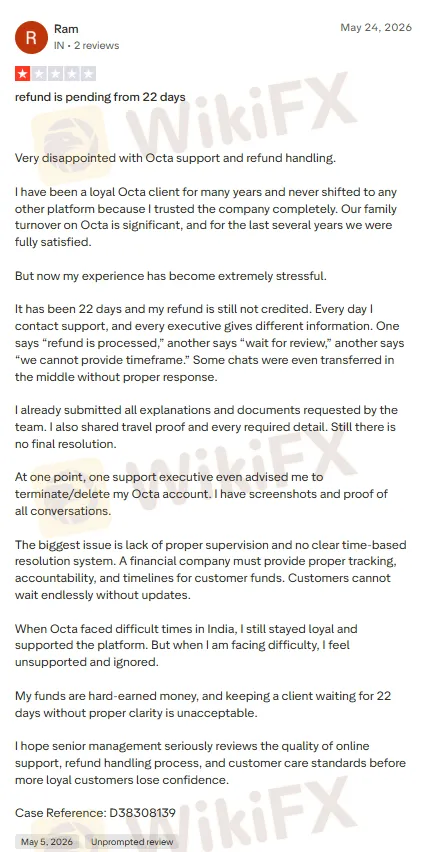
Octa user feedback is mixed and has deteriorated noticeably in the past 12 months. Specific complaints from Indian traders include the one that appeared in May 2026.
Core Allegation: The customer alleges excessive delays in refund processing, inconsistent communication from support staff, and a lack of transparency and accountability in handling their refund request.
XTB user feedback is generally positive, with high marks for:
XTB does receive complaints about:
But critically, XTB does not have a pattern of profit confiscation complaints. The complaint nature is operational, not existential.
On every meaningful criterion, XTB is the dramatically better-regulated, more transparent, and more institutionally credible broker:
HOWEVER — XTB does not accept Indian clients. This is the binding constraint.
If you are an Indian resident, the practical comparison is moot — you cannot legally open an XTB account. Your alternatives are:
Here is what most Indian traders do not realise: the RBI Alert List is updated periodically, but it is not the only verification you need to do. Even brokers not currently on the RBI list may have other red flags — clone firms operating under their name, regulatory licence mismatches, or accumulating complaint patterns.
Open the WikiFX app on your phone right now and verify any broker before you deposit. Here is what to check specifically:
WikiFX is the single most powerful verification tool retail traders have, and it is free. The traders who lost funds to Octa's profit-voiding scheme could have seen the warning signs on WikiFX before depositing. Do not repeat their mistake.
Trade smart. Verify first. Choose Tier-1 regulation over Tier-3 leverage every single time.
Download the WikiFX App for extensive broker investigation reports.

More Insightful Articles for You
Disclaimer:
The views in this article only represent the author's personal views, and do not constitute investment advice on this platform. This platform does not guarantee the accuracy, completeness and timeliness of the information in the article, and will not be liable for any loss caused by the use of or reliance on the information in the article.

OANDA review for India covering global regulation, RBI forex rules, OANDA login security, platforms and regulatory history.
This TPFx review examines PT Trijaya Pratama Futures, Broker Code 4461810512, its Bappebti record, the Q1 2026 A+++ assessment, look-alike website warning, product costs, withdrawals and complaint route for traders researching an Indonesia forex broker.

The Fed releases the July FOMC minutes on 19 August 2026. Here are three USD and gold scenarios, confirmation signals, and a practical risk checklist for traders.
Angel One, an India-based brokerage entity, constantly receives allegations from users online. Users are complaining about withheld funds, poor customer support service, undesired trade execution orders, etc. In this Angel One review, let’s quickly go through these complaints, understand its regulatory framework and pay attention to the product portfolio.
WikiFXWikiFXWikiFXWikiFXWikiFXWikiFXWikiFXWikiFXWikiFXWikiFX