

Global Broker Regulation Inquiry App
About WikiFX
English
简体中文
繁體中文
English
Pусский
日本語
ภาษาไทย
Tiếng Việt
Bahasa Indonesia
Español
हिन्दी
Filippiiniläinen
Français
Deutsch
Português
Türkçe
한국어
العربية
اردو


Why Going All In on One Forex Trade Can Wipe Out Your Account

WikiFX
|


Abstract:What all-in positions actually control, why large drawdowns need much larger gains to recover, and a hypothetical walkthrough of sizing a trade to a fixed risk.

Forex is a market where currencies are traded.
Position sizing determines the size/notional exposure of a position. The amount of account equity actually at risk depends on the stop distance, pip value, execution and other factors. Equity means the account balance plus any open profit or loss.
Many beginners think the fastest way to grow a small account is to put everything into one trade they feel very confident about. Going all in means using all available capital on a single position. That is not a strategy. It is a choice to let one losing trade decide whether a trader can keep trading. Position sizing, as a practice, is built to reduce that possibility.
A common beginner mistake is to think risk is only about stop-loss distance, or that a small account must be traded all in. The core idea is different: a single trade is usually considered too large if it can erase a trader's ability to continue. Margin and leverage can make large positions look affordable, but risk is the amount that could be lost if price reaches the stop, not the margin deposit. Margin is the money a broker sets aside as collateral to open a leveraged trade. Leverage is the tool that lets a trader control a larger position with a smaller amount of their own money.
 Contents
The Recovery Maths Every Beginner Needs
The arithmetic behind an all-in loss is asymmetric. A loss of a certain percentage needs a larger percentage gain just to get back to the original account size. This is arithmetic, not a prediction about any trade. Drawdown means the fall in account equity from a peak to a trough.
- A 10% loss needs an 11.1% gain to recover.
- A 25% loss needs a 33.3% gain to recover.
- A 50% loss needs a 100% gain to recover.
- A 90% loss needs a 900% gain to recover.
If a trader goes all in and loses 90% of an account, the remaining 10% must grow by 900% just to break even. That is a much harder climb than most beginners realise. A run of losing trades is possible even with a sound plan. Position sizing is commonly used so that such a run does not end a trading account before the arithmetic can work in the trader's favour.
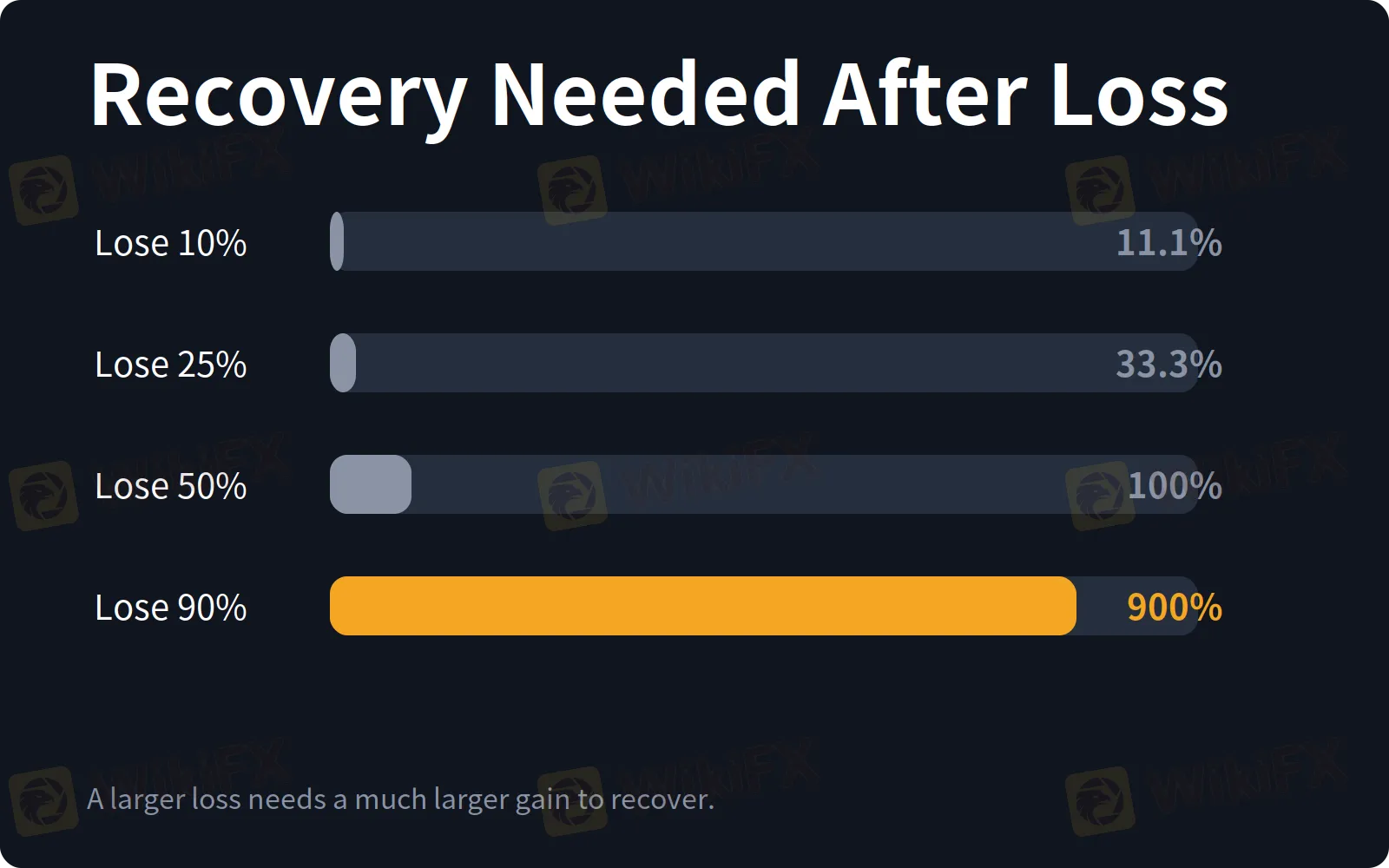
Percentage gain required to return to the original account size after a drawdown. Hypothetical arithmetic example.
How to Calculate Position Size: A Hypothetical Walkthrough
A pip is the smallest standard price move in a currency pair. For pairs quoted to four decimal places, one pip is usually 0.0001. A standard lot is 100,000 units of the base currency, which is the first currency named in a pair. A micro lot is 1,000 units. A stop loss is a pre-set order to close a trade if price moves against a position by a certain amount, limiting the loss.
One common method is fixed fractional position sizing. In this approach, a trader sets in advance what fraction of equity is at risk on a single trade, then uses the stop-loss distance to work out trade size. The formula is:
Position size = (Account equity × Risk per trade) ÷ (Stop-loss distance × Pip value per standard lot)
This is a hypothetical example, not a recommendation to trade any pair or use these exact numbers. Assume a trader's account equity is $10,000 and the planned risk is 1% of equity, which is $100. Assume the analysis, if one existed, would place a stop loss 50 pips away. For this teaching calculation, assume one standard lot moves $10 for every pip.
- Step 1: Risk amount = $10,000 × 0.01 = $100.
- Step 2: Loss if one standard lot moves 50 pips against the position = 50 × $10 = $500.
- Step 3: Position size = $100 ÷ $500 = 0.20 standard lots, or 20 micro lots.
If the stop is hit, the loss is about $100, which is 1% of the $10,000 account. If the stop were 100 pips away instead, the same $100 risk would allow only 0.10 standard lots. Trade size is not chosen by confidence or account balance alone. It comes from the risk amount and the stop distance.
Common Misunderstandings That Cost Beginners Money
A few wrong ideas show up repeatedly among new traders.
- “One good trade will solve everything.” Even if a trade looks high quality, the outcome of any single trade is uncertain. An all-in position turns that uncertainty into a binary event: either the account wins big or it may be badly damaged.
- “High leverage means I do not need much capital, so all in is fine.” Leverage increases the size of a position that can be controlled, but the potential loss is still based on the full position size and price movement. A small margin deposit can lose far more than the margin if the market gaps or if there is no stop.
- “Small fixed-fraction risk guarantees profits.” It does not. Risking a small fraction per trade does not by itself improve win rate or create a statistical edge, which is a lasting advantage over many trades.
- “Spreading across several pairs removes all-in risk.” If those pairs are highly correlated, they can move together like one oversized position. Correlated means their prices tend to move in similar directions.
- “A fixed dollar risk stays safe forever.” As an account grows or shrinks, a fixed dollar amount becomes a different percentage of equity. What was once a 1% risk can silently become a 5% risk after a few losing trades.
Position sizing controls the size of a loss if a trade goes against a trader. It does not tell a trader which direction to trade, when to enter, or whether a setup will work. The reason all-in positions are usually seen as dangerous is not that one all-in trade always loses. It is that a single adverse move can end a trader's ability to keep trading, and no amount of confidence changes the arithmetic of recovery.
Disclaimer:
The views in this article only represent the author's personal views, and do not constitute investment advice on this platform. This platform does not guarantee the accuracy, completeness and timeliness of the information in the article, and will not be liable for any loss caused by the use of or reliance on the information in the article.
WikiFX Broker
Latest News
Spec Capital Group Secures ASIC Licence for Wholesale CFD Services
WikiFXadmiral Review 2026: Clone Warnings, Withheld Profits, and Withdrawal Risks
WikiFXInteractive Brokers changes overnight order default in TWS
WikiFXGhana cedi jumps 6.9% against dollar in one week
WikiFXExclusive Capital Review: Regulated by CySEC, but Traders Report Withdrawal Problems
WikiFXWHITEFOREX Review: Is Your Deposit Safe?
WikiFXGold Climbs Toward $4,400 as September Fed Hike Odds Tumble
WikiFXASIC Pulled 19,400 Scams as AI Deepfakes Target Investors
WikiFXInteractive Brokers Changes Overnight Order Default in TWS
WikiFXStoneX Agrees to Acquire Brazil FX Bank Banco Travelex
WikiFX