

Global Broker Regulation Inquiry App
About WikiFX
English
简体中文
繁體中文
English
Pусский
日本語
ภาษาไทย
Tiếng Việt
Bahasa Indonesia
Español
हिन्दी
Filippiiniläinen
Français
Deutsch
Português
Türkçe
한국어
العربية
اردو


Why Full-Time Trading Shrinks Your Identity and Feeds Loneliness

WikiFX
|


Abstract:A full-time trading transition can quietly shrink your identity to a single profit-and-loss number. This article explains why that creates loneliness and shows a hypothetical, non-directive way to build a broader personal scorecard for traders.
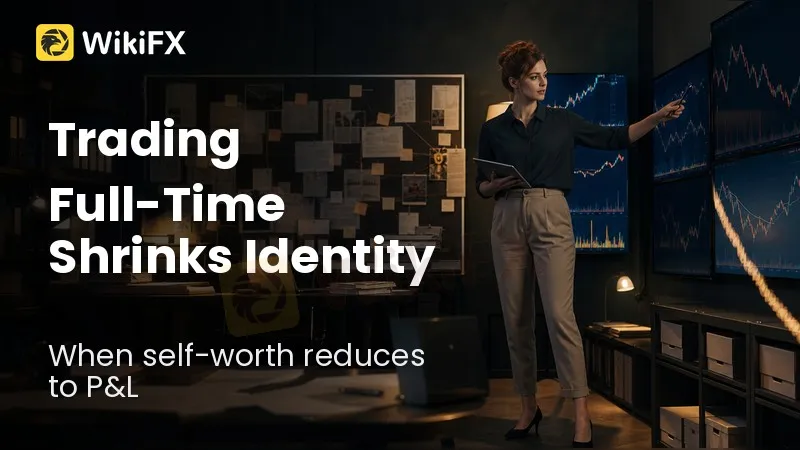
When someone leaves a salaried job to trade full-time, they rarely picture the silence. They imagine freedom: no boss, no commute, charting the foreign exchange market from home. What they often miss is that a job provides more than income. It supplies a daily rhythm, a social role, and a quiet answer to the question “Who am I?”
Take away those anchors and the trading account can become the only mirror. Identity, in plain terms, is the story you tell yourself about what you are worth. A full-time transition often replaces a multi-room house with a single room: the profit-and-loss column. You could call this narrowing an identity contraction, but it is a descriptive label rather than a formal diagnosis. It is not a character flaw; it is an easy trap when you sit alone with a screen that updates your value every second.
 Contents
When Trading Eats Your Identity
The shift rarely announces itself. It starts with small trade-offs: skipping lunch with friends to watch the London session, checking the balance before brushing your teeth, measuring a good day only by account growth. Over time, these small choices change what you notice and what you ignore. The trading result becomes the loudest voice in the room, and everything else becomes background noise.
A beginner often misunderstands this process. They assume that once the results improve, the loneliness will disappear. But results are volatile by nature, meaning they can swing sharply and unpredictably; a losing streak can happen to a careful trader just as an impulsive trade can produce a lucky win. If self-worth is attached only to the outcome, every loss becomes a threat to who you are, not just a temporary dip in your account balance.
A job used to provide what you could call belonging cues: simple signals that you belong to a group, such as a colleague asking about your weekend, a shared complaint about deadlines, or a boss acknowledging your work. A full-time trader usually loses these cues. The only audience may be a brokerage app that shows a green or red number. Without a social role, small talk becomes harder because you cannot explain your day to people outside trading in a way that feels real.
Why Single-Point Worth Feels Lonely
When you judge yourself by one number, you start hiding the parts that do not fit. A losing week feels like a secret failure, so you avoid calls with family or you answer “fine” when asked how work is going. Shame thrives in secrecy. The less you share, the less connection you feel, and the more the screen becomes your only companion. This is not weakness; it is a predictable response to a narrowed identity.
To make this concrete, consider a hypothetical Malaysian full-time trader, Amir. On Monday he followed his written plan exactly: he risked no more than 1 percent of his account on any single trade, took two setups, and ended the day down 0.4 percent. On Wednesday he broke his plan, chased a fast move, and made 1.2 percent.
If Amir's only scorecard is his account balance, Wednesday feels like a better day than Monday. But a process-based scorecard, one that rates whether he followed his plan rather than the outcome, would rate Monday higher because he did what he said he would do, and Wednesday lower because he rewarded impulsive behaviour. This is a hypothetical teaching example, not a record of real trades and not advice to trade in any particular way. The point is that a single number cannot tell you who you are.
Building a Broader Personal Scorecard
A multi-dimensional evaluation means rating your day on several separate areas, not just profit. For traders, the most useful areas are usually process, learning, and connection. Process asks whether you followed your own written plan, regardless of result. Learning asks what you noticed about your reactions under stress. Connection asks whether you spoke to someone outside trading or did something unrelated to the market.
You do not need a complicated journal. Each evening, write one short sentence for each area. Then give each area a simple 1 to 5 rating. A rating of 1 means “barely present”, and 5 means “fully present”. This is observation, not self-punishment. At the end of the week, look for patterns rather than totals. You might notice that your best process days followed a full night's sleep, even if those days were not profitable. That is useful information because it points to a stable lever you can observe without trying to predict the market.
A simple weekly review can follow this loop: separate process from outcome, rate areas beyond profit, track life anchors such as sleep and mood, and review the week with curiosity rather than judgement. During that review, watch for these common thinking traps:
- All-or-nothing thinking: one losing trade means “I am a failure” instead of “this trade failed”.
- Result bias: judging a decision only by its immediate outcome, ignoring whether the process was sound.
- Social withdrawal: avoiding friends because you feel you have nothing impressive to report.
- Comparison loops: scrolling other traders' results and feeling behind, even when their risk or situation is different.
None of this means trading results do not matter. They do, because a full-time trader needs a sustainable edge, meaning a repeatable advantage, and strict risk control to stay in business. But making profit the only measure of personal worth is a category error: you are treating a volatile performance metric as if it were a stable human identity. That is why the identity shift can feel so lonely: you are trying to befriend a number that changes every minute.
A broader scorecard cannot remove loneliness, but it can let you notice that you are more than the last candle (the most recent price move on a chart). For a beginner, the first step is not to change your trading. It is to notice which parts of your life have stopped receiving attention since the transition. That observation, done calmly and without judgement, is already a form of multi-dimensional evaluation.
Disclaimer:
The views in this article only represent the author's personal views, and do not constitute investment advice on this platform. This platform does not guarantee the accuracy, completeness and timeliness of the information in the article, and will not be liable for any loss caused by the use of or reliance on the information in the article.
WikiFX Broker
Latest News
Review 2026: GFS Withdrawal Complaints, Regulation Gaps, and Broker Risk Signals
WikiFXStoneX Agrees to Acquire Brazil FX Bank Banco Travelex
WikiFXPlus500 Joins Bahamas Forex and CFD Industry Association
WikiFXInteractive Brokers changes overnight order default in TWS
WikiFXInteractive Brokers Changes Overnight Order Default in TWS
WikiFXGhana cedi jumps 6.9% against dollar in one week
WikiFXReview 2026: XORKETS FX Withdrawal Complaints and Unregulated Risk
WikiFXadmiral Review 2026: Clone Warnings, Withheld Profits, and Withdrawal Risks
WikiFXTenTrade Review 2026: Complaints, Withdrawals, and Risk Signals
WikiFXGold Climbs Toward $4,400 as September Fed Hike Odds Tumble
WikiFX